Guest journey & upsells
How a small page of extras sent before arrival turns the questions you already answer by WhatsApp into bookings your staff can see and plan around.
Mark Noble, Direct Belize · 2 November 2026 · 5 min read

The questions arrive anyway. "Can you arrange a pick-up from the airstrip?" "Is there a cart available for the week?" "We'd like to do the cave tubing on our first full day — can you sort it?" Usually at nine at night, usually on WhatsApp, usually while you're doing something else.
You answer them, because that's the job. The trouble is that the answering is scattered. One request sits in a phone, another on a sticky note by the desk, a third in somebody's head. Then the guest arrives and the cart isn't there.
An upsell portal is a small fix for that. It's a page of the things you already offer, linked from the message that goes out before arrival. The guest taps what they want. The request lands on their booking, where staff can see it.
What the guest actually sees
Not a shop. A short list.
A few days before the stay, the guest gets the pre-arrival message you've already set up — WhatsApp or email, whichever they prefer. Near the bottom there's a line about extras, and a link.
The link opens a plain page with your items on it: snorkel trip, golf cart, transfer, early check-in. Each one has a name, a short description, a price in BZ$. The guest taps the ones they want and that's the end of their part.
On your side, the request appears against the booking in the admin, and the notification bell tells somebody it's there. Nothing is charged automatically and nothing is confirmed automatically. A person checks: is the cart free that week, is the boat running with enough people on it, can housekeeping have the room ready by eleven. Then you confirm, and take the money at the desk or send a payment link through your own Stripe account, the same as any other payment.
That matters more than it sounds. Half the extras a Belize property sells depend on something you can't see from a web form — the tide, the guide's other group, whether the road to the cave is passable after three days of rain. The portal collects the request. You still decide.
Building the catalogue
Start with what you already say yes to. Go back through last month's messages and write down every extra a guest asked you to arrange. Most properties find six to ten things, and three of them account for nearly all of it.
What tends to sell, by place:
- Caye Caulker and San Pedro — golf cart hire by the day or week, snorkel trips, water taxi timings, late check-out on departure day when the boat isn't until the afternoon.
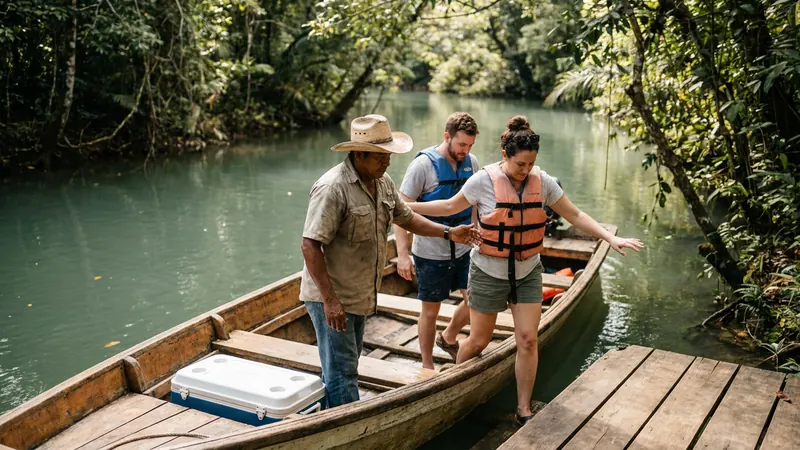
- Cayo and San Ignacio — cave tubing, the ATM day trip, Xunantunich, a packed breakfast for an early start, transfer from Belmopan or the Western Highway.
- Placencia and Hopkins — airport transfers, fishing and snorkel charters, drumming lessons, a fridge stocked before arrival for guests coming in late.
- Punta Gorda and Corozal — guided days out, border and bus connections, a cooked dinner on the first night when nothing else is open.
- Everywhere — early check-in, late check-out, room upgrade, airport or shuttle pick-up, anniversary set-up.
Write each one in the words a guest would use, not the words you use with your staff. Say what's included and what isn't — entrance fees, lunch, whether the guide collects from the property or you drive them to the meeting point. Price it at exactly what you'd quote at the desk; a different number online is how arguments start.
And leave off anything you can't reliably deliver. A list of four things that always happen beats a list of fifteen with three disappointments in it.
Why before arrival beats the front desk
Timing does most of the work here. The guest-journey messages go out at set points — confirmation, a few days before arrival, arrival day, after check-out — and the extras belong mainly in the before-arrival one.
By then the booking is real, the guest is planning, and they're usually sitting with whoever they're travelling with. At the desk they're hot, carrying bags, and there may be two other people waiting behind them.
The published figures back that up. Studies of pre-arrival upselling report conversion rates of 8–35% on offers sent before the stay, and an average of around US$95 added per booking. The same research reports guests are roughly 80% more likely to accept an upgrade before arrival than when it's offered at check-in.
Those are other people's numbers, from properties very unlike a six-room guesthouse in Hopkins. Treat them as a reason to try it, not as a forecast.
The arrival-day message is a good second chance for the short-notice things: early check-in, a transfer, dinner on the first night. After check-out, the message does a different job — it asks for the review, with the Google and TripAdvisor links in it. Don't sell there.
You can see how the whole sequence fits together on the guest journey feature page.
A tour desk without the spreadsheet
For a larger property this stops being a convenience and starts being the system.
A hotel in the 15–25 room range usually has someone who co-ordinates tours — part front desk, part phone calls to guides. Traditionally that runs on a whiteboard, a notebook and a group chat, and it works until the person doing it takes a week off.
With requests attached to bookings, the information lives where everyone looks anyway. The co-ordinator gets a staff login with view and edit on bookings and nothing else. Front desk sees the same screen when a guest asks at the counter. Housekeeping sees that room nine has an early check-in and plans the morning around it. The permissions matrix means each person sees their own part without being able to delete anybody else's.
The admin is the same whether you have four rooms or twenty-five — Starter covers 1–6 rooms, Growth 7–14 and Pro 15–25, and the difference is how many logins are in use, not a different piece of software. The pricing page has the detail.
Start small and prune it
Pick six items. Run them for a season. In the quiet months, look at what sold, what nobody touched, and what caused a complaint, and cut accordingly.
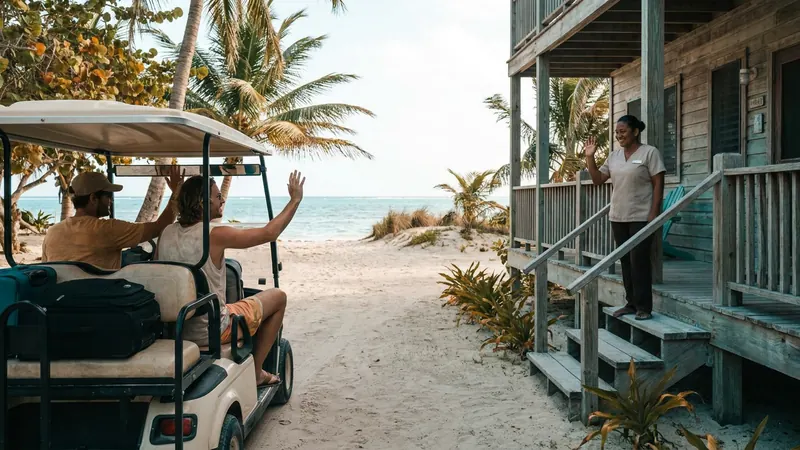
The goal isn't a bigger menu. It's that the cart is waiting under the palms when the guest walks down from the water taxi dock, because somebody wrote it down three days earlier — and the guest wrote it down themselves.
Sources
- 1.Direct Belize — Features — what the guest-journey messages, upsell portal and staff permissions include today.
- 2.Direct Belize — Pricing — the room bands for Starter, Growth and Pro.
- 3.BookingWhizz — Pre-arrival upselling — reported conversion rates and average value added per booking.
- 4.Gnosari — Hotel upsell benchmarks — reported difference between accepting an upgrade before arrival and at the desk.