AI concierge
How an AI concierge decides to stop answering and pass a guest to your staff, what the guest is told, and how a late arrival at 11 p.m. actually plays out.
Mark Noble, Direct Belize · 31 October 2026 · 6 min read
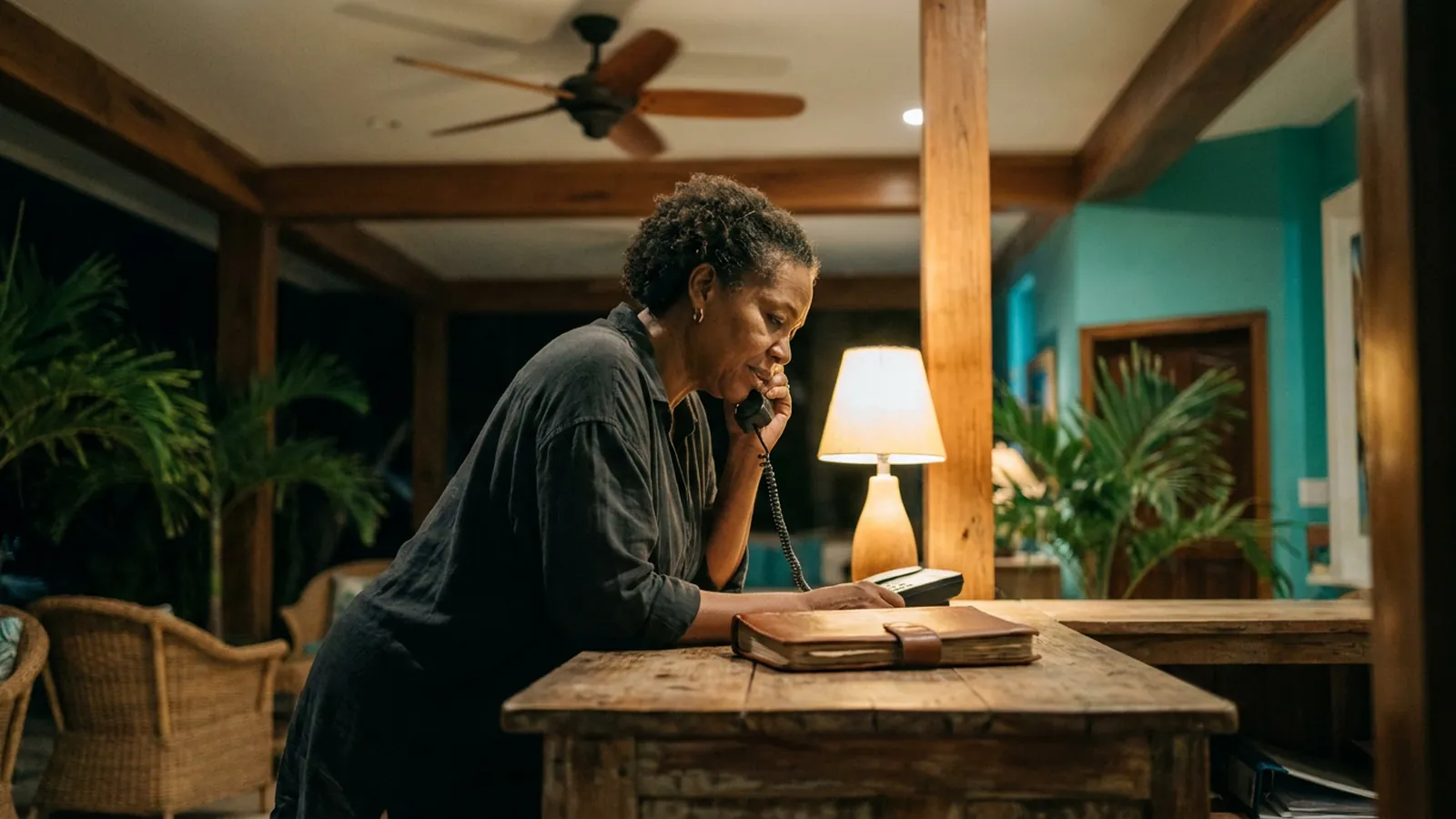
Most of the questions that arrive on your website chat or WhatsApp after dark are not hard. What time is check-out. Is there air conditioning in the garden room. Do you take dogs. How far is the bus terminal. Is breakfast included.
A guest asking those at nine in the evening does not need you personally. They need an answer.
Research into guest messaging reports that 82% of travellers expect an immediate reply — within about five minutes — when they message a business online, and 40% expect one within the hour. The same body of work reports that hotel chat assistants can handle more than half of routine questions, over 52%, without a person getting involved.
That leaves a good deal that is not routine. The part of an AI concierge worth thinking carefully about is not the answering. It is the handover.
What the concierge is allowed to say
The concierge on a Direct Belize site answers from approved facts: the things you have written down about your property. Rates, policies, room descriptions, directions, what is and is not included, the name of the tour operator you work with, how the water taxi schedule affects arrivals.
If the answer is in there, it gives it. If the answer is not in there, it does not reach for something plausible. It does not decide that a late check-out is "usually fine" because most small hotels are relaxed about it. It does not quote a rate it has not been given. It does not invent a cancellation policy.
A concierge that guesses once has cost you more than one that says "let me get someone" a hundred times.
This matters more in Belize than it might elsewhere, because so much of what guests ask depends on things only you know. Whether the road to the lodge is passable this week. Whether the generator is on a schedule. Whether the boat captain will do a six in the morning run in low season. There is no general knowledge to fall back on, and a confident wrong answer about a transfer from Placencia airstrip is a guest standing somewhere in the dark.
The four moments it stops and asks for a person
The handover is not a judgement call made fresh each time. It happens in four situations.
- A complaint. Anything that reads as dissatisfaction — the room, the noise, a charge, a member of staff — goes to a person. The concierge does not apologise on your behalf and does not offer anything.
- A keyword you chose. You decide these. Refund. Cancel. Allergy. Wheelchair. Medical. Police. Group booking. Wedding. Whatever your property wants a human eye on, you list, and the chat stops there.
- Low confidence. When the question does not match the approved facts closely enough, it hands over rather than stretching. A vague question about "the other room with the view" is better passed on than guessed at.
- A request outside the facts. Anything that would require a decision — holding a room, waiving a fee, moving a booking, a special rate for a long stay — is a decision, not an answer. Decisions belong to staff.
You can tighten or loosen the keyword list at any time. A guesthouse in San Ignacio that keeps getting asked about cave tube bookings might add that word simply because they would rather answer it themselves and sell the tour properly.
What the guest is told, and what you see
The guest is told plainly that the question is going to a member of staff, and roughly when to expect them. Not "I'm sorry, I didn't understand that." Not a loop of the same three suggestions. The chat does not go quiet and it does not pretend.
If it is the middle of the night and nobody is on duty, the guest is told that too, and the conversation stays open. They can keep typing. Everything they add is waiting for whoever opens the admin in the morning.
On your side, the conversation appears with everything needing attention in the notification bell. A staff member with the right permissions opens it, reads what the concierge has already said — the whole thread is there, nothing hidden — and takes over. They type as themselves. The concierge stops answering in that thread while a person holds it.
When the matter is settled, they hand it back, and the concierge picks up routine questions again from the same approved facts. The guest does not have to repeat anything.
Who can take a chat is part of your staff permissions. A night receptionist might be able to answer and resolve but not refund; a marketing person might not see guest chats at all. The same AI concierge and handover setup runs in a two-room guesthouse in Hopkins and a 25-room hotel in San Pedro — the difference is how many logins are open and what each one is allowed to do.
Eleven at night, a guest who missed the bus
Here is the shape of it in practice.
A guest booked direct at a small hotel in Corozal messages at eleven. The bus was late out of Belize City and they will not arrive until well after midnight. Can they still check in?
The concierge checks the approved facts. The reception hours are in there. The late arrival procedure is in there — the night bell, where the key box is, that the gate is locked after ten. So it answers the factual part: yes, late arrival is possible, here is the bell, here is what to do at the gate.
Then the guest asks whether someone can meet them at the terminal.
That is not in the approved facts. It is a request for a decision. The concierge says it is passing the question to staff and that someone will reply. It does not promise a pickup and it does not refuse one.
The night receptionist sees the badge, opens the thread, reads the two exchanges already there, and replies in one line: yes, a taxi will be waiting, the driver's name is written down, pay him BZ$ at the gate. Three minutes of a person's time, on the one part of the conversation that needed a person.
The guest arrives at half past midnight to a light on and someone expecting them. That is the whole point of the design.
Setting the boundaries before you switch it on
The work is in the approved facts and the keyword list, and it is worth an hour with whoever answers the phone most often. Write down the questions you are tired of answering, and separately, the questions you would never want answered without you. The first list is what the concierge handles. The second is what it hands over.
Review it after a month. You will find questions you did not anticipate sitting in the handover queue, and most of them can simply be added to the approved facts so the concierge answers them next time.
If you want to talk through what that looks like for your property, or what plan fits the number of rooms you run, get in touch.
Sources
- 1.Direct Belize — Features — what the concierge, handover and staff permissions include as of October 2026.
- 2.Direct Belize — Pricing — plan sizes from 1–6 rooms up to 15–25 rooms.
- 3.Conduit — Hospitality chatbot statistics — reported share of routine hotel questions handled without a person.
- 4.Heyy — Guest messaging expectations — reported traveller expectations on reply times.