OTA sync
A step-by-step front desk flow for phone and WhatsApp bookings, from checking the calendar to the confirmation email, without the notebook in between.
Mark Noble, Direct Belize · 10 September 2026 · 5 min read
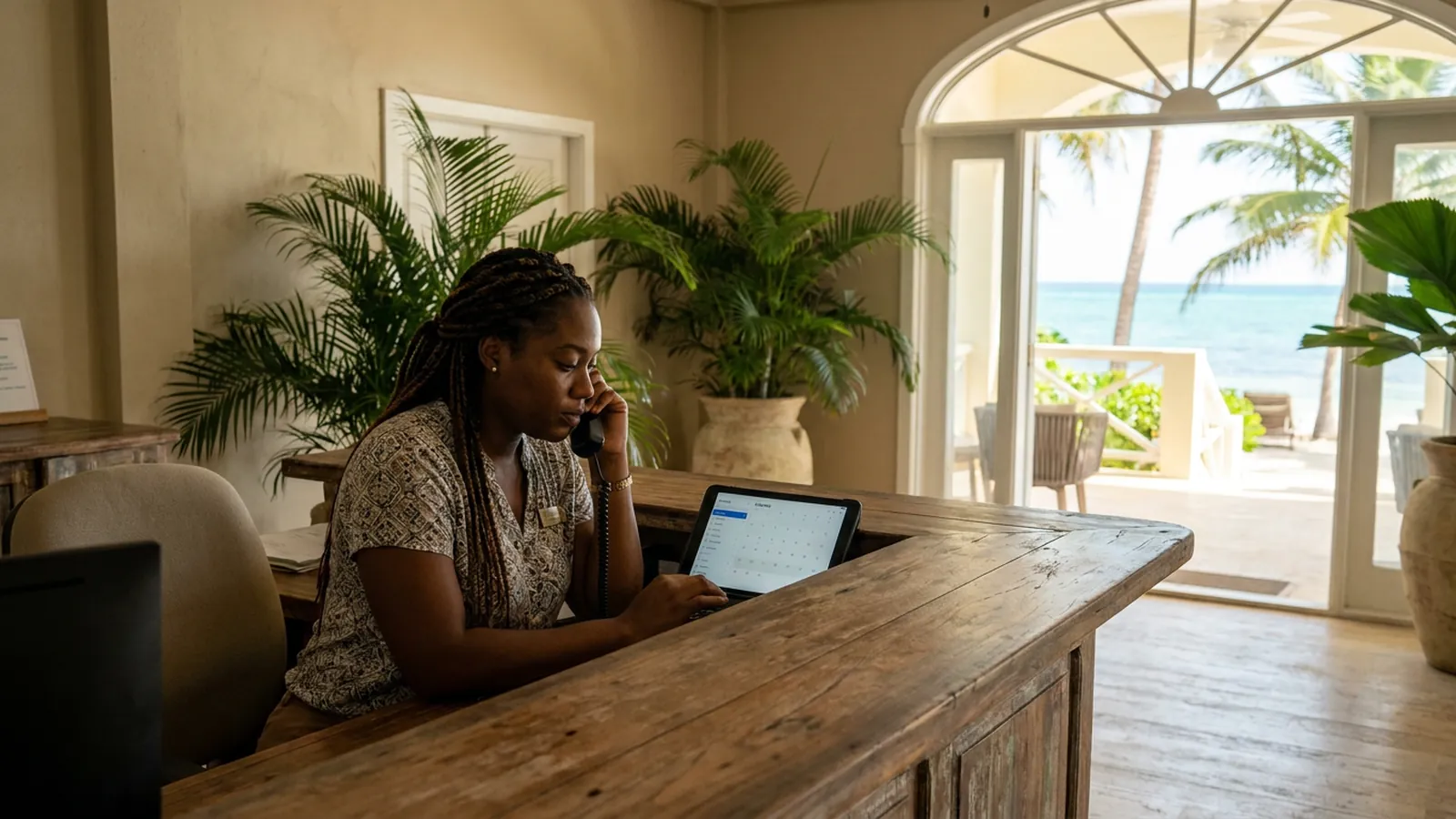
The phone rings at half past four. A woman who stayed with you two years ago wants the same room for the first week of December, three nights, two adults. She has your number saved from last time. She would rather deal with you than go through a booking site.
This is the best kind of enquiry. No commission, a guest who already likes you, and a conversation that takes four minutes. It is also, on a busy property, one of the easiest ways to end up with two parties holding the same room on the same night.
The difference is almost never how careful the person at the desk is. It is whether the booking goes straight into the system, or sits somewhere else first.
Where double bookings begin
They begin in the notebook.
Not because notebooks are bad. A notebook is quick, it works when the internet is down, and every front desk in Cayo has one. The problem is the gap. Between the moment you write "Mrs Reyes, Dec 1–4, Room 3" on the pad and the moment someone types it into the system, that room is still showing as available everywhere. On Booking.com. On Airbnb. On Expedia. On your own site.
That gap might be ten minutes while you finish the call and deal with a guest who has lost a key. It might be until the end of your shift. On a Saturday in Placencia it might be until Monday morning.
Ten minutes is enough. Someone in Houston books Room 3 for the first week of December while the ink is still wet, and now you have a phone call to make that nobody enjoys.
The second failure mode is quieter. The booking never leaves the notebook at all. The page gets turned, the guest arrives in December, and nobody is expecting her.
The notebook is not the problem. The gap between the notebook and the calendar is the problem.
The flow, start to finish
Here is what the call should look like when the booking goes in as you speak.
Check the calendar while she is still talking. Open the calendar on the tablet or the desk screen before you quote anything. You are looking at one calendar that already reflects every booking site you are listed on, so what you see is what is actually free. If Room 3 is taken for the second night, you find that out now, not after you have promised it.
Quote and confirm the dates out loud. "First of December, checking out on the fourth, so that is three nights." Say the room name. Say the rate. Repeat it back. Most date errors are caught here if you say them twice.
Enter the booking in the admin while you are on the phone. Name, dates, room, number of guests, rate, a phone number or WhatsApp number, and anything she mentions — late arrival, ground floor, no stairs. The guest is still on the line, so you can ask rather than guess. This takes about as long as writing it on the pad.
Mark it as pay-at-property. For a direct booking taken over the phone, the guest settles with you at the property. If you want to hold the room with a deposit, that goes through your own Stripe account and lands in your bank — Direct Belize never touches the money. For a repeat guest you know, pay-at-property is usually fine. For a long stay in high season, a deposit is reasonable. That is your policy, not ours.
Let it close the night everywhere. Once the booking is saved, that room stops being available for those dates on every channel you are connected to. You do not log into Booking.com, then Airbnb, then your own site. The admin and channel sync handles that part, which is the whole reason the booking goes in while the guest is still on the phone rather than later.
Properties using a channel manager report up to 20% more bookings and around 80% fewer overbookings, and those listed on more than three channels report roughly 65% more bookings than properties on a single channel. Those are other operators' numbers, not a promise about yours — but the overbooking figure is the one that matters at the front desk, and it comes from exactly this: closing the room once, everywhere, at the moment the booking is made.
The reference and the confirmation email
When you save the booking, it gets a reference. Read it to her before you hang up.
That reference is the thing you both point at when something needs changing. She rings in November to add a night, and instead of "I spoke to someone, maybe in September, about December" you have one number that pulls up the whole booking. If three different people work your desk, as happens in most guesthouses, this is what stops the booking from becoming folklore.
Then the confirmation goes out by email or WhatsApp. It carries the dates, the room, the rate, the reference and your arrival instructions. Two things happen:
- She has it in writing, so she stops worrying and stops ringing to check.
- You have a record that she received the dates you both agreed, which is useful on the rare occasion that memories differ.
The same thread later carries your pre-arrival message — directions from the junction, what time the water taxi gets in, whether to book the cave tour in advance.
The WhatsApp version
Most of these enquiries now arrive as WhatsApp messages rather than calls, especially from guests already in the country. The flow does not change.
Check the calendar before you reply. Answer with the room, the dates and the rate in one message. When she says yes, enter it in the admin, mark it pay-at-property, and send the confirmation. Do not leave a "yes we have it" sitting in the chat for an hour while you deal with lunch service — that is the notebook gap wearing different clothes.
If you want to see how this looks on your own rooms and rates, get in touch. Setup is usually done within a couple of weeks, there is no long-term contract, and the site and the data stay yours.
The booking sites will keep sending you guests, and they have earned their commission on those. Mrs Reyes, who has your number saved and rang you directly, is a different matter. Take that booking cleanly, and it costs you nothing but four minutes.
Sources
- 1.SiteMinder — Channel manager benefits — reported gains in bookings and reductions in overbookings for properties using a channel manager.
- 2.Little Hotelier — Channel manager guide — reported booking differences between properties on one channel and those on several.
- 3.Direct Belize — Features — what the admin, calendar sync, deposits and messaging actually do.