OTA sync
One working day at a small Belize hotel, from the morning arrivals list to the evening notification bell, handled on one screen instead of three.
Mark Noble, Direct Belize · 21 October 2026 · 6 min read
Most of the work at a small hotel is not dramatic. It is a list of small things done in the right order, and the cost of a bad system is not one disaster but a hundred small frictions: the notebook that someone else has, the WhatsApp group where a message scrolls past, the spreadsheet that was right yesterday.
So here is an ordinary day at a fictional twelve-room place in Hopkins, done entirely inside one admin. Nothing clever. Just the normal shape of a Tuesday.
Half past six: the arrivals list
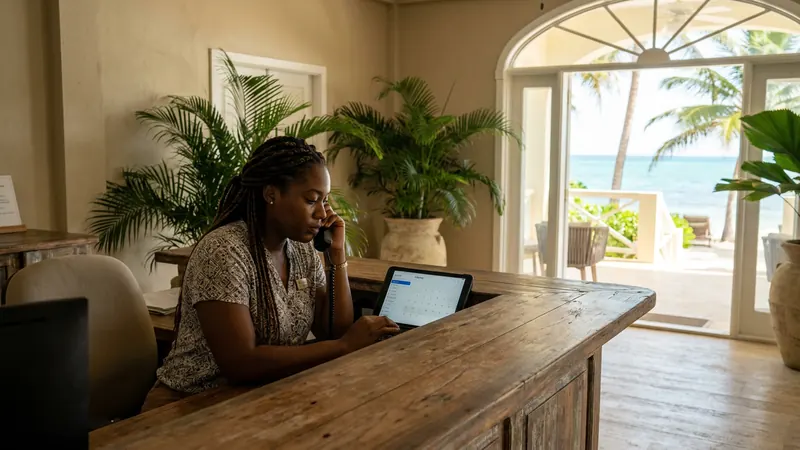
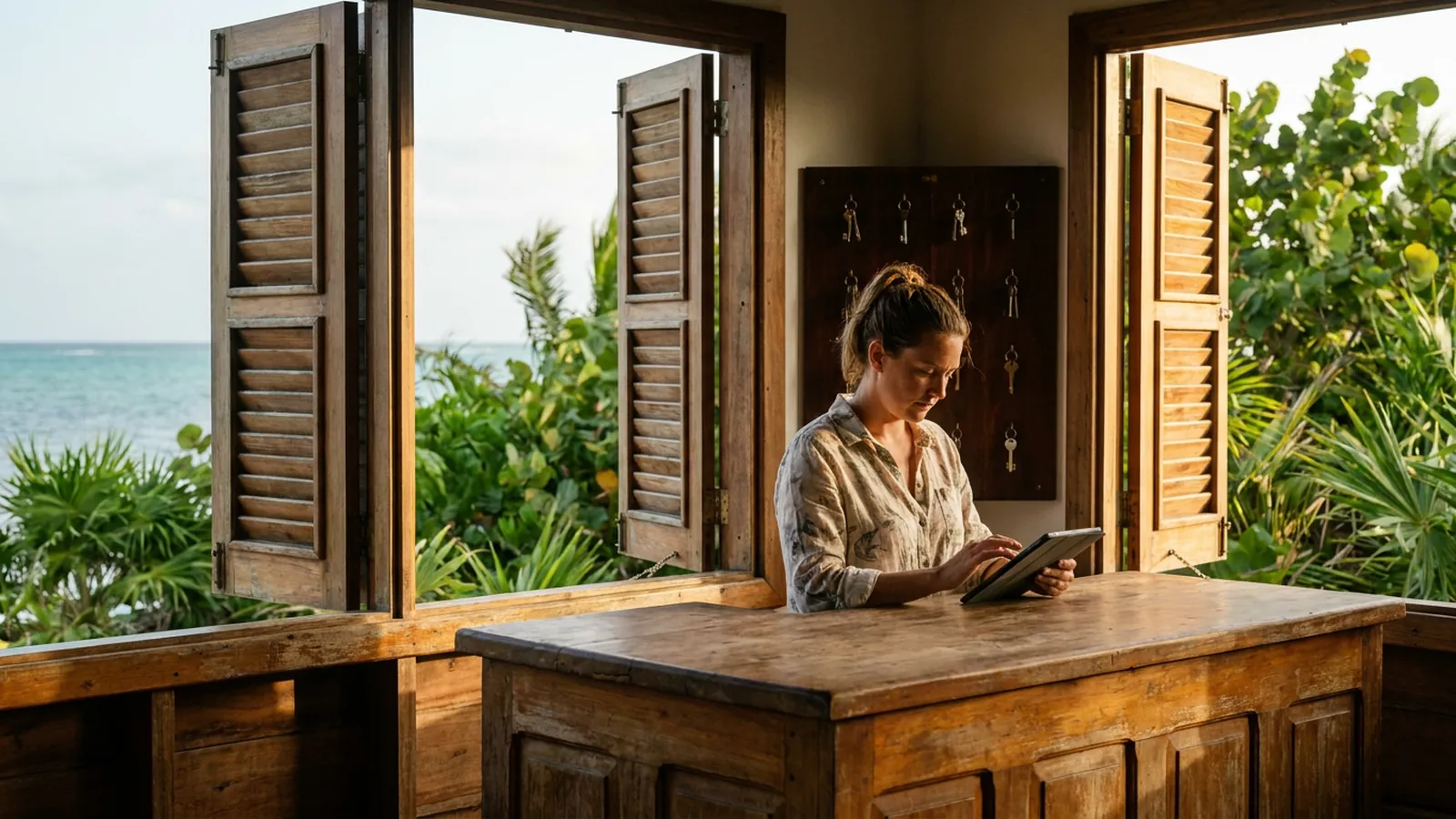
The first thing the front desk person does is open the dashboard on a tablet while the coffee is going. Today there are arrivals and departures and one room that needs attention.
The arrivals list shows who is coming, which channel they booked through, what they paid and what is outstanding. The departures list is what housekeeping will work from. Both come from the same calendar, which is synced both ways with Booking.com, Expedia, Airbnb, Vrbo and Google, so a cancellation that came in overnight on Airbnb has already taken that room off the list.
That is the part people underestimate. The arrivals list is only useful if nobody has to reconcile it first. When the calendar is one calendar, the morning starts with reading rather than checking.
Two of today's arrivals have early-flight notes attached. One has bought an airport transfer through the upsell portal in the pre-arrival message, so that is already on the day's plan rather than a surprise at eleven o'clock.
Half past nine: a walk-in, and no double booking
A couple come up from the road. They have been in Placencia, the bus was slow, and they want two nights.
The front desk person opens availability on the same screen. Room 7 is free tonight and tomorrow — genuinely free, because the calendar that the website sells from is the calendar the booking sites sell from. She creates the booking, takes the guests' details, and the room goes off sale everywhere within the sync.
This is the step that used to produce the worst phone calls. A walk-in gets written in the book, nobody updates the extranet, and an hour later someone in Toronto books the same room on Expedia. The fix is not more discipline. It is one calendar that every channel reads.
The couple pay at the desk on departure, which is how most direct bookings work here. If the property wanted a deposit at the point of booking, that would run through the property's own Stripe account and land in the property's own bank — Direct Belize never holds the money.
The walk-in is the clearest case of the whole argument. That guest was standing in reception. No booking site brought them. There is no reason to pay commission on them.
The booking sites earn their commission honestly on the guests they find. The point is simply to stop paying it on the ones who were already at the door, or already on the website.
Eleven: a message from Booking.com, answered where you are
A guest arriving Thursday asks, through Booking.com, whether there is parking for a hire car and whether the kitchen does breakfast before seven.
The message appears in the admin with an unread badge, on the booking page for that guest. The front desk person reads it there and answers there. No separate extranet login, no second tab, no "I'll do it after lunch" and then not doing it after lunch.
Speed matters more than most of us would like it to. Studies of traveller behaviour report that 82% of people expect an immediate reply — within about five minutes — when they message a business online, and 40% expect one within the hour. That is a hard standard for a twelve-room property with one person on the desk.
Which is why the AI concierge sits on the web chat and WhatsApp, answering only from the facts the property has approved, and handing over to a person when the question is beyond it. Chat assistants in hotels are reported to handle over 52% of routine questions without a person. Parking, check-in times, whether the water is drinkable, how far to the bus. The messages that reach the desk are then the ones that actually need a human.
Two o'clock: a cleaning job closed from a phone
Room 4 departed at ten. The cleaning job for it was created automatically from the departure, so it was on the housekeeper's phone before she started.
She finishes, marks it clean, and the room's status changes on the board the front desk is watching. No shouting up the stairs, no asking twice.
She also flags the shower mixer in Room 9 as a maintenance job, marked high priority. The manager sees it and puts an out-of-order hold on Room 9 for two nights, which takes it off sale on every channel until the plumber has been. A room that cannot be sold should not be sellable. That is a one-click decision, not a four-place update.
Housekeeping, maintenance and the out-of-order hold all live in the same place as the arrivals list, which is the whole argument for a single admin rather than a set of good tools that do not speak to each other.
Four o'clock: a deposit recorded
A group booking for Christmas week comes in by email from a family in Belmopan. The desk sends a payment link through the property's Stripe account, the deposit is paid, and it appears on the ledger for that booking.
When they arrive in December, whoever is on the desk will see exactly what has been paid and what is outstanding, without looking it up in an email thread from October. The payouts report keeps the owner's side of it tidy.
If you want to see how the permissions work — who on your team can see payments, who can only see the arrivals list — the admin and staff tools page sets out the View, Edit, Create and Delete matrix. A two-person guesthouse in Corozal and a 25-room hotel in San Pedro run the same system; the difference is how many logins are in use and what each one can touch.
Six o'clock: tomorrow, and the bell
Before handover, the desk opens tomorrow's arrivals. Four rooms, one late arrival on the last water taxi from Caye Caulker, one guest returning for the third time. Arrival-day messages will go out automatically in the morning.
That night the owner, at home, opens the notification bell on her phone. It holds what needs attention and nothing else: the maintenance job on Room 9, a review request that came back with four stars and an AI-drafted reply waiting for her to approve or rewrite, two price suggestions from the market intel for the week after next that she can accept one by one or ignore. Nothing changes rates by itself. Nothing gets published without a person saying yes.
She reads them in about the time it takes to finish a cup of tea, approves one price, edits the review reply, and puts the phone down.
That is the day. Not a transformation — just the same work, in one place, with fewer things to remember. If you want to know what it costs for your number of rooms, the pricing page lists the three plans, and setup is usually done within a couple of weeks.
Sources
- 1.Direct Belize — Features — what the admin, channel sync and housekeeping tools include as of October 2026.
- 2.Direct Belize — Pricing — the Starter, Growth and Pro plans by room count.
- 3.Conduit — Hospitality chatbot statistics — reported share of routine hotel questions handled without a person.
- 4.Heyy — Guest messaging expectations — traveller expectations on reply times to online messages.