OTA sync
How a channel manager keeps one calendar across Booking.com, Expedia, Airbnb, Vrbo and Google, and what that looks like day to day in Belize.
Mark Noble, Direct Belize · 8 August 2026 · 5 min read
Most double bookings happen in the gap between two clicks.
A guest in Texas books your garden cabana on Booking.com one evening. A few minutes later, a guest in Mexico City books the same cabana on Airbnb. Nobody did anything wrong. The first site simply had no way of telling the second that the night was gone, and the person who would normally close it was asleep, or driving back from San Ignacio, or serving dinner.
You find out the next morning. Then comes the part nobody enjoys: ringing one of them, apologising, offering a different room or a neighbour's place, and quietly waiting to see whether the review mentions it.
Why the gap exists at all
Each booking site keeps its own copy of your availability. Booking.com has one. Expedia has one. Airbnb, Vrbo and Google each have theirs. None of them talks to the others.
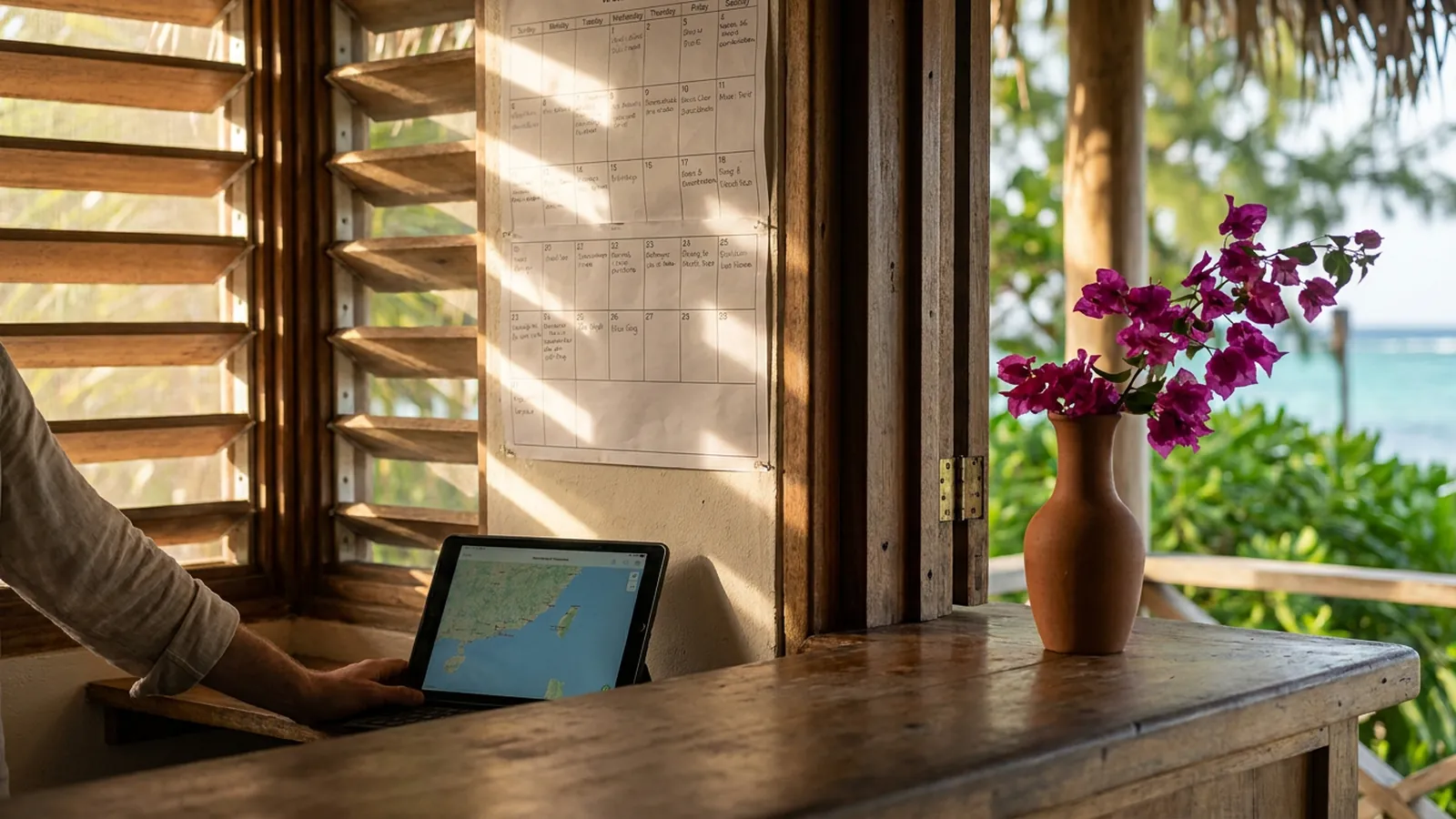
So the calendar on your wall — the real one, the one that's actually true — only becomes true on those sites when somebody logs in and makes it true. Five extranets, five passwords, five slightly different ways of saying "this room is closed on these dates".
Small properties handle this in sensible ways. Some only list on one or two sites to keep it manageable. Some hold back rooms as a buffer, never selling the last one online. Some assign the job to whoever is on reception and hope the handover is clean.
Each of those works, and each costs you something. Listing on fewer sites means fewer people see you. Holding back rooms means empty nights you could have sold. Relying on a handover means the one evening someone forgets.
What a channel manager actually does
A channel manager sits between your calendar and the booking sites. There is one availability calendar — yours — and it pushes to every connected site within minutes of anything changing.
That's the whole idea. Not clever, just consistent.
The useful part is what happens when a booking lands. Say a family books three nights in your Hopkins beachfront room through Expedia. The channel manager sees it, writes it into your calendar, and closes those three nights on Booking.com, Airbnb, Vrbo and Google. Nobody logs in. Nobody is woken up. By the time you look at your phone, it's already done.
It works the other way too. A walk-in guest takes your last room, your housekeeper marks it in the system, and that night disappears from all five sites before the guest has finished signing the register.
Operators who make this move report real differences. Properties using a channel manager report up to 20% more bookings and about 80% fewer overbookings. Properties listed on more than three channels report roughly 65% more bookings than those on a single site — which makes sense, because once you're not afraid of selling the same night twice, there's no reason to stay on one listing.
The point isn't that you sell on more sites. It's that you can sell your last room on all of them without flinching.
What it feels like on a Tuesday
Here's the honest version of day to day with sync running.
- You stop opening five tabs in the morning. The calendar you look at is the one all the sites are reading from.
- You stop keeping a safety room. If it's free, it's for sale everywhere.
- You stop dreading the shoulder weeks, when one cancellation used to mean a round of manual updates across every platform.
- When something does go wrong — a site being slow to accept an update, usually — you can see it, rather than discovering it at check-in.
It isn't magic and it isn't instant to the second. Sites take a few minutes to process changes. But a few minutes is a very different problem from a few hours.
How we set it up, and why you never see an extranet
Here is the part most owners ask about. Running a channel manager normally means another account to manage, another login, another thing to learn in a month when you're also fixing the pump and training a new cook.
We run the channel-manager account on your behalf. Direct Belize connects it to your listings, maps your room types, and keeps it working. You don't log in to Booking.com's extranet or Vrbo's dashboard to change availability. You work in one calendar, and the connections are our job.
Five channels are included on every plan: Booking.com, Expedia (which carries Hotels.com with it), Airbnb, Vrbo and Google. If you sell through something else as well, extra channels are BZ$29/month each.
Setup is typically done within a couple of weeks. There's no long-term contract, and the website, domain and data belong to you.
Plans are BZ$119/month for one to six rooms, BZ$279/month for seven to fourteen, and BZ$479/month for fifteen to twenty-five. Annual billing gets one month free and skips the setup fee; monthly billing carries a one-time BZ$499 setup fee. The pricing page has the detail.
The booking sites still earn their keep
None of this is an argument against the OTAs. A couple in Ontario who have never heard of Placencia will find you on Booking.com, and they wouldn't have found you otherwise. That's a guest the site brought you, and the commission on that booking is fair.
What's worth changing is the second half of the story: the guest who stayed with you in February, loved it, and comes back through the same listing in November because it's the only route they know. That booking carries commission too, and it shouldn't.
That's why sync and your own booking page belong together. Your site runs on your domain, takes direct bookings at 0% commission on every plan, and guests either pay at the property or leave a deposit through your own Stripe account. We never hold your money.
Your calendar stays honest across all five sites. Your returning guests have somewhere to book that costs you nothing. And nobody has to make the apology phone call.
Sources
- 1.SiteMinder — Channel manager benefits — reported booking and overbooking figures for properties using a channel manager.
- 2.Little Hotelier — Channel manager guide — reported difference between properties on one channel and more than three.
- 3.Direct Belize — Features — what's included, ownership of site and data, how deposits work.
- 4.Direct Belize — Pricing — plan prices, setup fee, included channels and extra channel cost.