Housekeeping
How a simple four-state housekeeping board stops guests being walked to unmade rooms and stops clean rooms sitting empty at a small Belize property.
Mark Noble, Direct Belize · 5 September 2026 · 6 min read
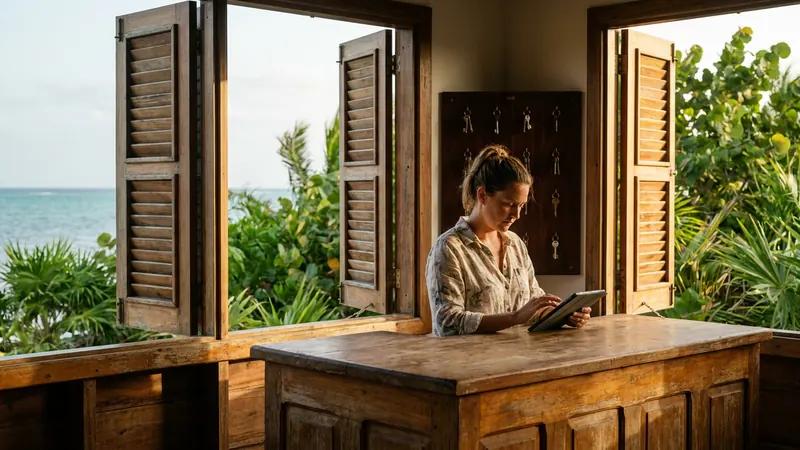
Ask anyone who has run a six-room guesthouse in San Ignacio for a few years and they will tell you the same thing. The hard part is not the booking. The hard part is the hour between eleven and noon, when two guests are leaving, one is sitting on the porch waiting for a taxi, somebody has walked in off the street asking about tonight, and only one person in the building actually knows which rooms are ready.
Most accommodation in Belize is like this: small, independently owned, often family-run, with fewer than 40 rooms. There is no housekeeping office. There is a sister, a cousin, two housekeepers and a phone. That works, right up until the moment it doesn't.
The two failures worth preventing
Nearly every housekeeping problem at a small property ends up as one of two failures.
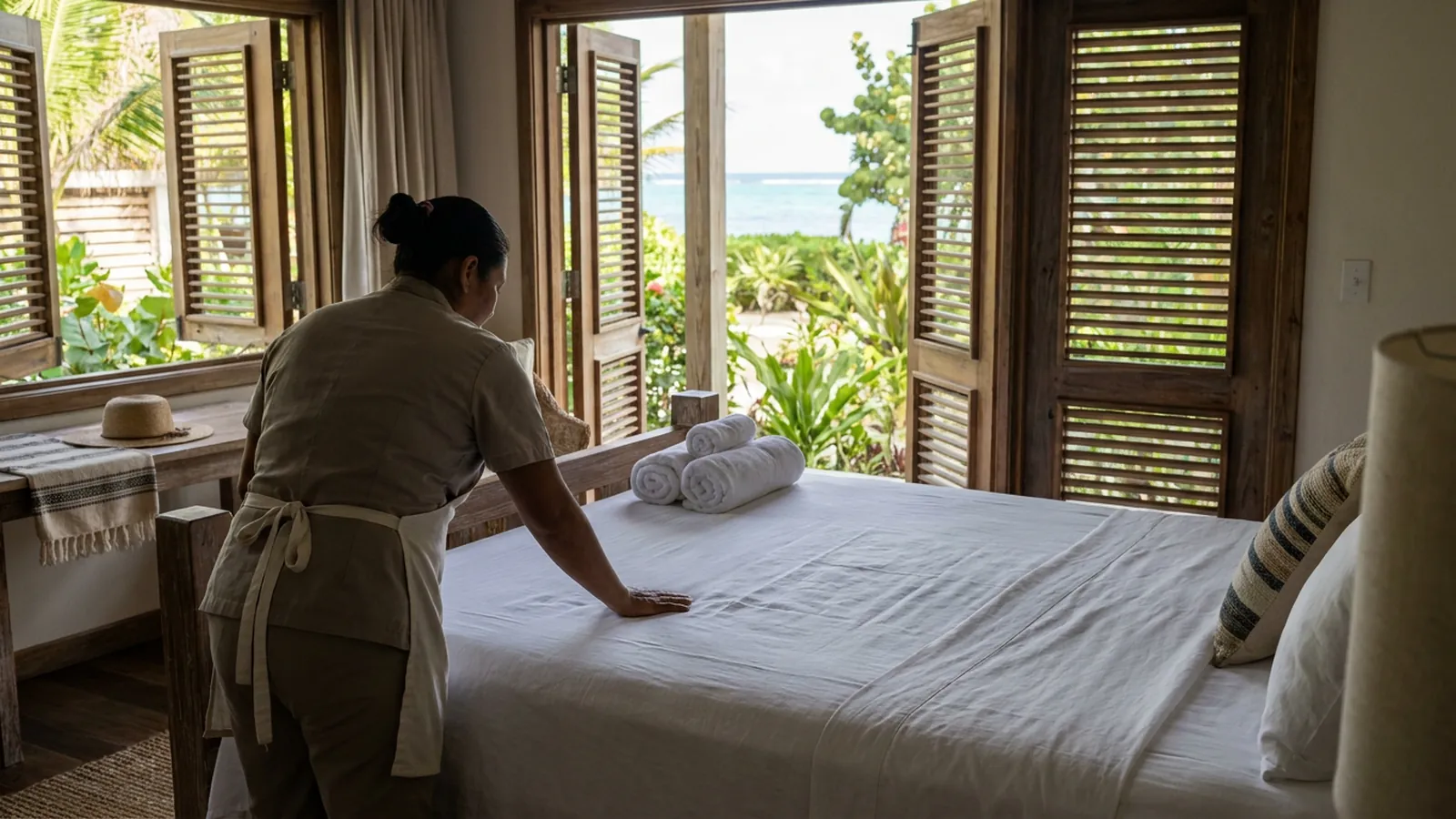
The first one everybody remembers. A guest arrives tired from the bus, you hand over a key, and the room has not been made up. Towels on the floor, bed stripped, bin not emptied. It is a small mistake and it costs you in a way that is hard to measure — the apology, the upgrade you didn't want to give, the sentence in the review about "not quite ready on arrival". That review sits there for a year.
The second failure nobody remembers, because nothing visible happens. Room 4 was cleaned at half nine. Nobody at the desk knew. A walk-in asked at eleven, was told the property was full, and went down the road. The room sat clean and empty all night. There is no complaint, no review, no awkward moment — just revenue that never existed.
The first failure is loud. The second is quiet and more common. A housekeeping system is really a way of catching the quiet one.
You cannot sell a room you don't know is ready, and you shouldn't sell one you know isn't.
Four words, one screen
The small-property version of a housekeeping system does not need to be clever. It needs four states and one place everybody looks.
- Clean — made up, checked, ready for a guest to walk into right now.
- Dirty — guest has gone, or the room needs servicing. Not sellable yet.
- In progress — someone is in there working. Don't send anybody, don't count it as ready, don't send a second housekeeper.
- Out of order — the air con is dead, the shower is dripping, the window screen is torn. Not sellable at any price until somebody fixes it.
That is the whole vocabulary. Each room carries one of those four, and whoever is on the desk sees all of them on their phone without walking the property or shouting up a staircase.
"Out of order" earns its place on that list. Every property has a room that quietly stops being rentable for a week because the fan broke and nobody wrote it down anywhere a manager would see. Giving it a status makes the problem visible, and visible problems get fixed.
"In progress" matters more than people expect. It is the difference between a housekeeper being interrupted three times before ten o'clock and being left to finish. It also stops the desk from promising a room that is twenty minutes away from being ready, which is the most common way the first failure happens.
Our housekeeping board is built around exactly those four states, per room, updated by whoever is standing in the room rather than by whoever is standing at the desk.
A morning at a six-room guesthouse
Here is what the routine looks like in practice. Adjust the times to suit your property — the shape is what matters.
Before seven. Whoever opens looks at the day: who is leaving, who is staying on, who is arriving and roughly when. Departures get flagged as dirty once the guest hands back the key. Stayovers get marked for servicing.
Seven to eleven. Housekeeping works the list. Each room goes to in progress when they walk in and clean when they walk out. Two taps. If the toilet is running or the mosquito screen has a hole, the room goes to out of order instead, with a note, and the owner sees it the same morning rather than on Friday.
Eleven to one. This is the window where money is won or lost. The desk can now answer three questions without moving: what is ready, what is close, what is not happening today. If a couple walks up from the bus stop in Hopkins asking about tonight, you know in two seconds whether you have a room and whether you can let them in at one o'clock or two.
Mid-afternoon. A quick look before check-in proper starts. Anything still dirty at three is a conversation, not a surprise at six when the guest is standing in the doorway.
Evening. One glance to confirm every occupied room is accounted for and tomorrow's departures are known. That is the handover.
Nothing here requires a new habit beyond two taps per room. What it removes is the asking — the phone calls up and down the property, the housekeeper being pulled off a bed to answer "is 4 done?", the manager walking the corridor with a biro and a scrap of paper.
How it sits beside the calendar
Housekeeping status and the booking calendar answer different questions, and both get asked at the same moment.
The calendar tells you whether a room is sold. Housekeeping tells you whether it is sellable. A room can be free on the calendar and useless to you because the shower is broken. A room can be clean and sitting there because last night's guest left early and nobody updated anything.
With one calendar kept in sync across your own direct site and the booking sites, you already know what is sold. Put the four-state board next to it and you know what you can actually hand over. That is when a late availability call stops being a gamble — and when a guest who books direct on your own domain gets a room that is genuinely ready, with no commission paid to anyone on a guest who was always going to come to you.
For a property with fewer than a dozen rooms, this is perhaps the least glamorous tool in the kit and one of the most used. It runs every single morning. If you want to see how it would fit your rooms and your routine before committing to anything, get in touch — setup is typically done within a couple of weeks, and there is no long-term contract.
Sources
- 1.Belize Hub — Accommodation in Belize — background on the small, independently owned, often family-run nature of Belizean accommodation.
- 2.Direct Belize — Features — housekeeping status per room, calendar sync, staff logins and setup terms.