Website & booking engine
How the Direct Belize payments add-on works with your own Stripe account: deposits, desk payments, payment links, refunds and one ledger per booking.
Mark Noble, Direct Belize · 25 October 2026 · 6 min read
Most of the guesthouse owners I talk to have the same quiet worry about direct bookings. Not the website, not the photographs. The money.
On Booking.com the card details sit somewhere safe and the booking feels solid. On your own site, a stranger in Calgary fills in a form, and then you wait. Will they turn up? Do you hold the room over Easter week for someone who has given you nothing but an email address?
That is what the payments part of the admin is for. It runs on your own Stripe account, so the money moves from the guest's card to your bank. Direct Belize never holds it, never touches it, and never sits between you and your own takings.
A deposit that holds the room
When payments are switched on, your booking engine can ask for a deposit or the full amount at the moment someone books. You choose which, and you choose the deposit amount.
The booking is held until the card clears. If the card fails, the room does not quietly disappear from your calendar while you wonder what happened.
This matters more than it sounds. Bookings made through the OTAs are cancelled about twice as often as direct ones — one study of 2025 bookings put OTA cancellations at 21.8% against 10.6% for direct. A deposit is part of why. Someone who has put a night's money down on a cabana in Hopkins has made a decision. Someone who clicked "reserve, pay later" has made a maybe.
You still decide the terms. Some lodges in Cayo take a one-night deposit and the rest on arrival. A small place on Caye Caulker with three rooms might take the whole stay up front in high season and nothing at all in September. The settings are yours.
The desk still takes cash, and the notebook updates itself
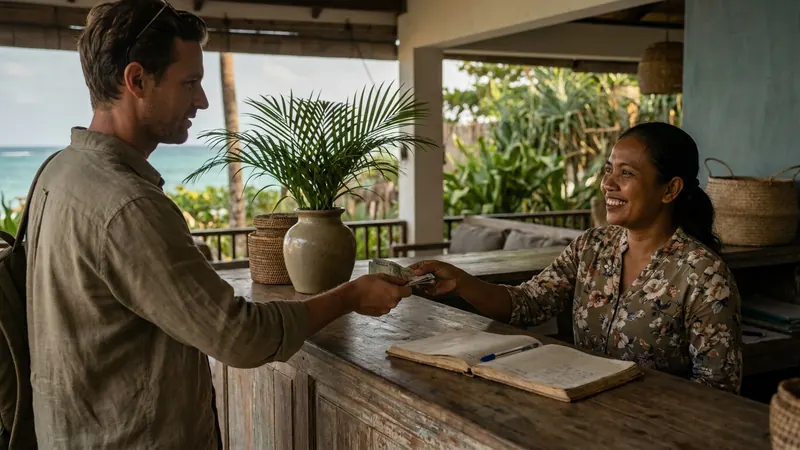
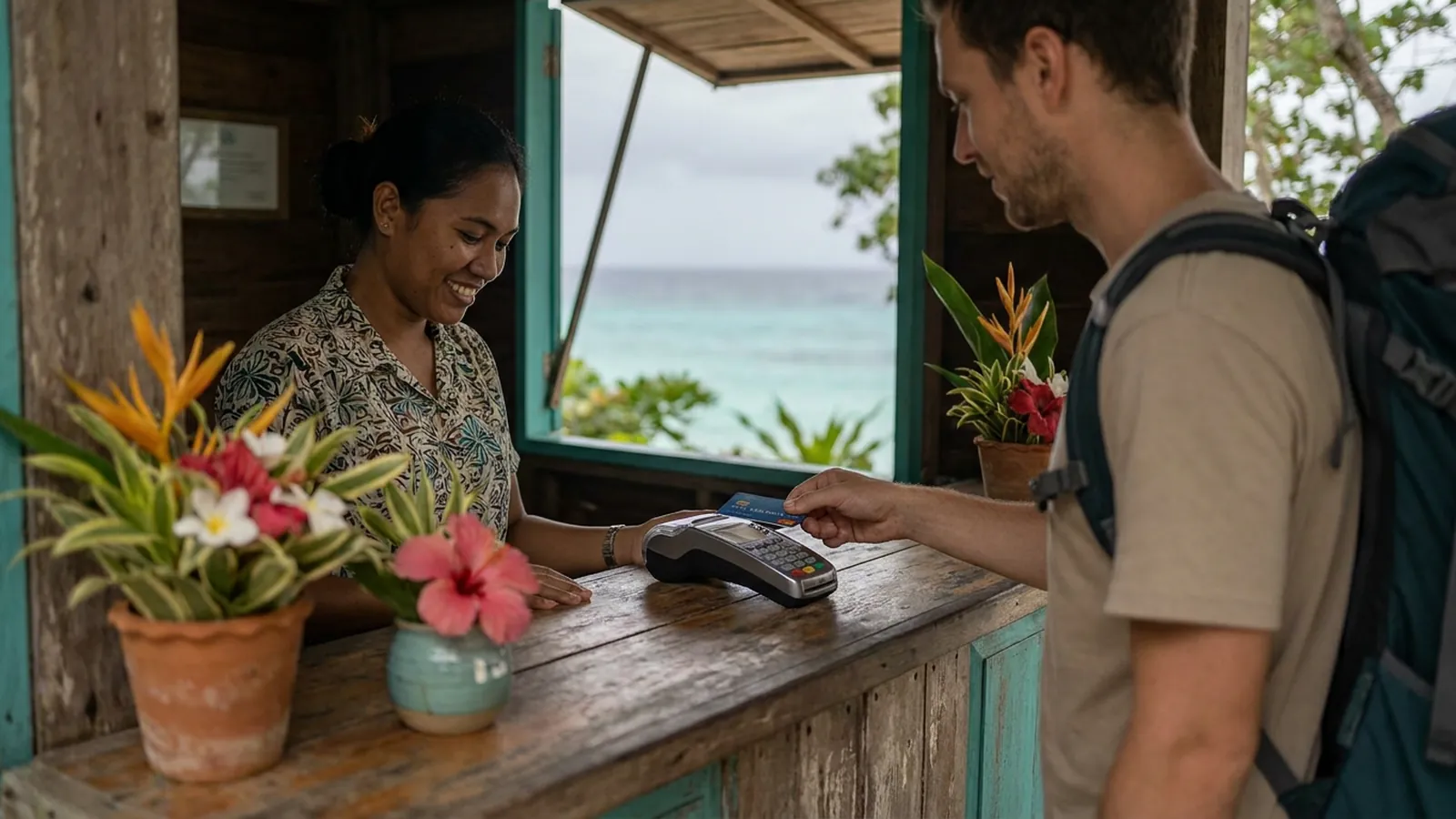
Nothing here forces guests to pay online. For a two-room guesthouse in San Ignacio, most people will still pay at the counter — cash, a card on your own terminal, a bank transfer from a Belizean account.
Those payments get recorded on the booking. You open the reservation, add what was paid, how it was paid, and the balance updates. The booking now shows what is owed instead of what you think is owed.
That is the whole difference between a notebook and a ledger. The notebook is fine until the day you are not there. Your sister covers the desk, takes a few hundred dollars in cash from the family in room 2, writes it on a slip of paper, and the slip goes into a drawer. Three days later nobody can say whether that family paid the balance or the deposit.
With a ledger per booking, every payment, every refund and every outstanding amount sits in one place, attached to the reservation, visible to whoever is on shift.
The question is never "did we take the money". It is "can anyone else find out that we took it".
Payment links, and refunds without a trip to the bank
Two small things that save a surprising amount of time.
The first is the payment link. A guest books, pays nothing, then writes a week later saying they would rather settle before they fly. You send them a payment link by email from the booking. They pay, it lands in your Stripe account, and the ledger on that booking updates. No back-and-forth about account numbers, no photographs of transfer receipts.
The second is refunds. A guest cancels within your terms, or a storm closes the road to Placencia, or you simply decide to be generous because they have stayed with you four times. You refund from the same page you took the money on, in full or in part. The booking records it.
Compare that to the usual: a trip into town, a transfer form, a fee, and a guest in another country waiting to see whether anything arrived.
At the end of the month there is a payouts report showing what Stripe has sent to your bank and what it took in fees. You can reconcile against your statement without exporting anything or guessing which deposit belonged to which stay.
Two rooms or twenty-five, one record
This is where the size of the property changes what the feature is actually for.
In a small place, the value is certainty. You are often the only person taking money, and the ledger is mostly there so that the one week you are in Belmopan with family, the place does not fall apart.
In a 15 to 25-room hotel in San Pedro or Corozal, the value is different. You have a front desk with three people on rotation, a manager, maybe an owner who drops in on Fridays. All of them touch money. Without one record you get three versions of the truth and an argument on the last day of the month.
The admin handles both because it is the same system either way — the difference is how many staff logins are in use and what each person is allowed to see, edit or delete. Your front desk staff can record payments without being able to delete them. Your read-only accountant can view the payouts report without touching a booking. Larger properties than 25 rooms are set up individually.
You can see how the plans are divided on the pricing page; the payments piece sits alongside the booking engine on your own domain rather than being a separate product to learn.
What it is not
It is worth being plain about the edges.
- Direct Belize does not process cards itself. The deposits run through your Stripe account, opened in your property's name.
- Payouts, fees and timings are Stripe's, not ours. The report shows you what happened; it does not change it.
- Nothing is automatic that should be a decision. You set the deposit, you decide the refund, you approve it.
And none of this is a reason to drop the OTAs. Booking.com and Airbnb bring you guests who would never have found you, and they earn their commission on those. The point of taking a deposit on your own site is narrower: the guest who already knows your name, who found you through a friend in Hopkins or a review, should not cost you commission to book. Operators who put a direct booking engine and proper guest messaging in place report shifting somewhere between 15 and 30% of their bookings over to direct in time, though it varies a good deal by property and nobody can promise it.
A deposit that holds the room is a large part of making that shift stick.
Sources
- 1.Direct Belize — Features — what the payments add-on and the wider admin include as of October 2026.
- 2.Direct Belize — Pricing — how the plans are divided by room count, and how staff logins differ by size.
- 3.HospitalityOS — Hotel direct booking vs OTA economics 2026 — 2025 cancellation rates for OTA versus direct bookings.
- 4.Heeya — Direct booking case notes — operator reports of bookings shifting from OTAs to direct.
- 5.Conferbot — Hotel chatbot results — further operator reports on direct booking and guest messaging.