Website & booking engine
What a traveller sees when they search your property's name, why your own site should sit in that price box, and five things to fix on Google this week.
Mark Noble, Direct Belize · 1 October 2026 · 5 min read
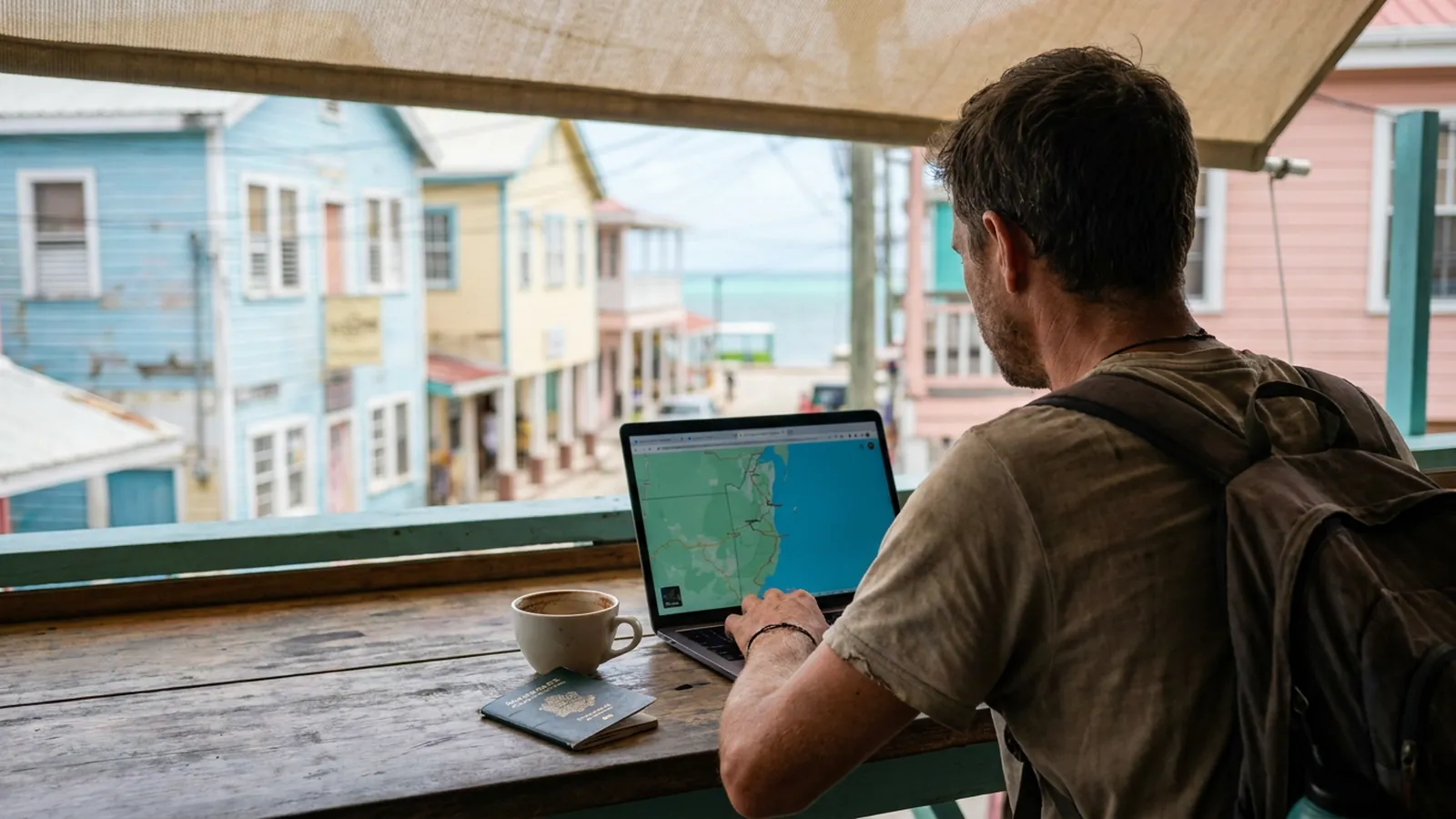
Think about how a guest finds you. Someone in Calgary or Dallas decides, over a long winter, that this is the year they finally see Belize. They don't start on a booking site. They start by typing "Belize jungle lodge" or "Placencia beachfront" into Google. They read a blog post, watch a short video, look at a map, and somewhere in that hour they land on the name of your property.
Then they do the thing everybody does. They search your name directly.
That search is the moment that matters, and most owners have never looked at it properly. So open a private browser window, type in your property's name, and see what a stranger sees.
What shows up when someone searches your name
On a phone, the first thing above the search results is usually your Google Business Profile: the name, the star rating, a photo, the map pin, the phone number, the opening hours, the reviews. Below that, if Google has recognised you as a place to stay, there's a panel with dates in it and a row of prices. Each price has a name beside it — the booking sites, mostly. Tap one, and off the guest goes.
That panel is the price box. It is the last fork in the road before a booking. The guest has already chosen you; the only question left is who they walk through to get to you.
If your own website is not in that row, the answer is always somebody else. You pay commission on a guest who had already typed your name into Google. They weren't browsing. They weren't discovering you. They were looking for you.
This is worth saying plainly, because it is easy to get cross about it: the booking sites are not the villains here. A guest who found you on Booking.com while comparing twenty places in San Ignacio is a guest the site brought you, and the commission on that booking is fair. The problem is the other sort — the guest who read about you, searched your name, and then got funnelled through a third party anyway. You're paying a finder's fee to someone who didn't find them.
What the direct route is worth
Hotels that have got themselves into Google's hotel search — the free booking links and Hotel Ads — report that guests acquired that way cost considerably less than the equivalent OTA commission. Not free. There is still cost and still work. But a meaningful difference on every booking, on a channel where the guest was already halfway to your door.
The same pattern shows up further upstream. Google search traffic to hotel sites converts at roughly 3 to 8 per cent; Meta ads convert at roughly 1 to 3 per cent. Someone searching has intent. Someone scrolling has a thumb.
That's not an argument against social media. It's an argument about where your first hour of effort goes. Before you boost a post, make sure the people already looking for you by name can find your own front door.
A guest who types your property's name into Google has already chosen you. The only question left is who they book through.
Five things to do on your Google profile this week
None of these need a developer. They need an afternoon and the password to your Google Business Profile.
- Claim it, if you haven't. Plenty of properties in Hopkins and Corozal have a Google listing created by guests, not owners — a pin, a few photos, hours that are wrong. Claim it and you control it. If someone else claimed it years ago and left, Google has a process for taking it back.
- Set the category correctly. "Hotel", "Resort", "Guest house", "Lodge", "Vacation rental" — these are not cosmetic. The lodging categories are what make Google treat you as a place to stay and show the dates-and-prices panel at all. A guesthouse filed under "Tourist attraction" will never appear in the price box.
- Fix the photos. Replace anything dark, blurry, or taken a decade ago on an old phone. Lead with the room as it actually is on a Tuesday, the view a guest actually gets, the breakfast table. Local and destination content — what a day here looks like, how you get here from the airport — outperforms promotional material for hotels. The same is true of photos. Show the thing, don't sell it.
- Answer every review, including the good ones. Two sentences, your own voice, no template. A guest reading your profile on a cafe laptop in Belize City is reading your replies as much as the reviews.
- Make the website link go somewhere that can take a booking. This is the one that undoes all the others. If the link on your profile points at a Facebook page, or a site with a contact form and no availability, the guest goes back to the price box and picks a booking site. Your own domain, your own booking engine, your own calendar.
The calendar is the part that bites
The reason a lot of owners never put their own site in the price box is a sensible fear: double bookings. If the site is selling the same room as Booking.com and Expedia and Airbnb, somebody is going to end up sleeping on the veranda.
That's a solved problem, and it's the part to get right before anything else. One calendar, synced both ways with the booking sites you already use, so a direct booking on your own site closes the room everywhere else within minutes. You can read how our two-way channel sync works if you want the detail.
With that in place, your website stops being a brochure and starts being a channel — the cheapest one you have, on your own domain, with your own data, and the guest paying at the property or leaving a deposit through your own Stripe account.
Setup is typically done within a couple of weeks, and there's no long-term contract. If you'd like to see what it would look like for your property, get in touch and we'll walk through your current Google listing with you first. That part costs nothing, and you may find it's the cheapest booking channel you've been ignoring.
Sources
- 1.Track360 — Google Hotel Ads vs OTAs — reported acquisition cost difference between Google hotel search and OTA commission.
- 2.RateGain — Hotel direct booking vs OTA — direct booking economics compared with OTA channels.
- 3.GetHostAI — Hotel marketing conversion benchmarks — conversion rates for Google search traffic against Meta ads.
- 4.Mediaboom — Hotel content marketing — local and destination content outperforming promotional posts.
- 5.Direct Belize — Features — what's included in the website, booking engine and channel sync.